Open farmland in Middle Tennessee. Photo: Carol M. Highsmith / Library of Congress (public domain), cropped
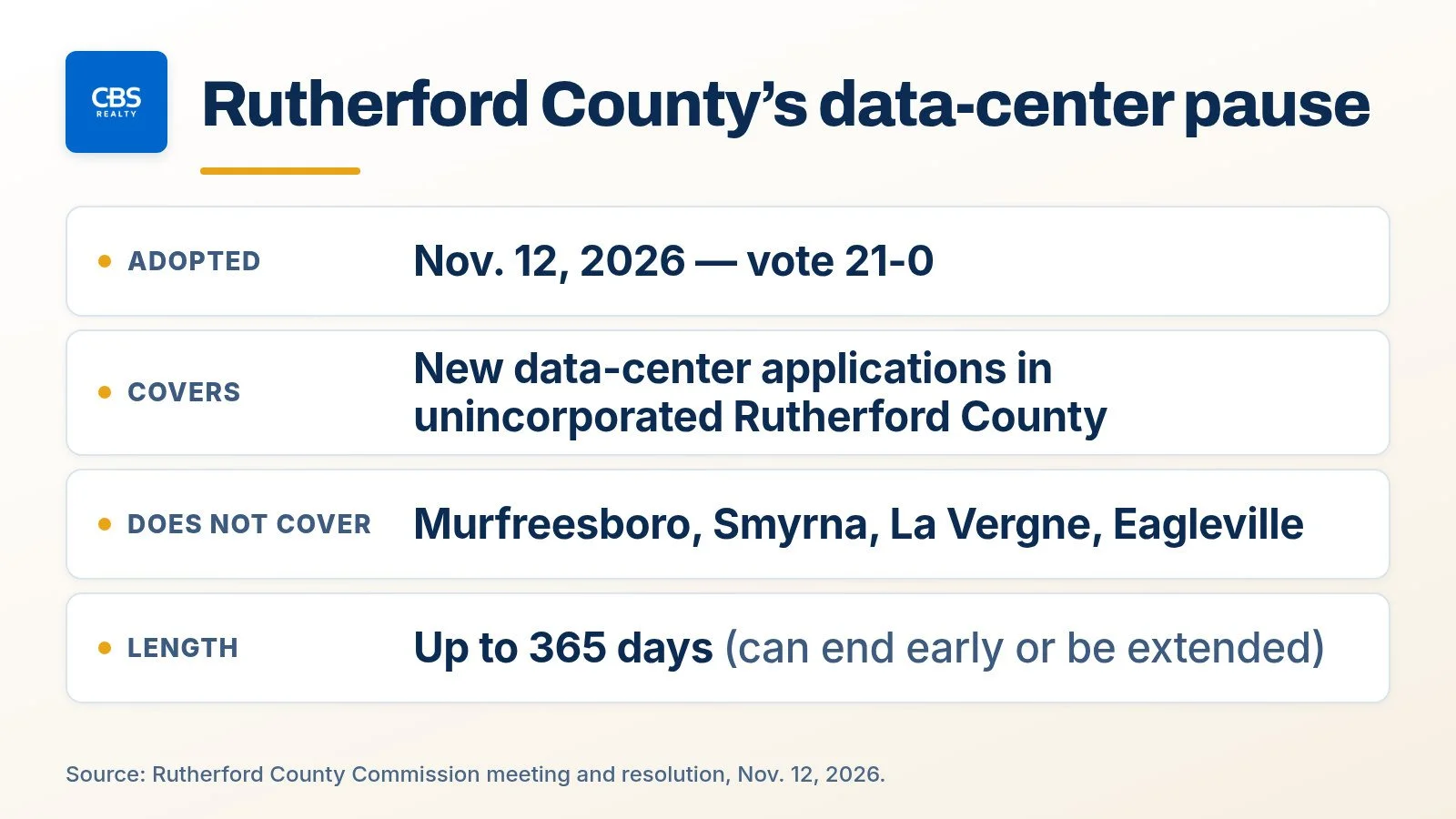
Rutherford County's data-center pause is now in effect. On November 12, all 21 commissioners present voted yes on a resolution that stops the county from accepting or processing new land-use applications for data centers in unincorporated areas for up to a year, according to the county's RCTV video of the meeting.
The vote did not stop a project, because there was nothing to stop. "I haven't received any phone calls, so there's nothing pending right now," Planning Director Doug Demosi told commissioners. For land and industrial investors, the vote settles one question and moves attention to three others: which government controls a site, what its zoning actually allows, and who pays for the power.
What passed
The resolution covers new data-center applications in every zoning district under the county zoning ordinance, including planned unit developments. Demosi said it also covers requests to convert an existing building into a data center. The text before the Commission, which we reviewed in our November 9 preview, set a November 12 effective date. The pause ends after 365 days unless the Commission ends it sooner or extends it.
Both exits came up on the floor. Demosi said the pause could end at the same meeting where permanent rules are adopted, and that the resolution lets commissioners extend it if the rules are not ready. He said little is likely to get done before the end of the year. Staff will start from model regulations prepared by a state planning center, which can limit data centers by power use as well as square footage.
Until then, the county has no data-center use in its zoning code. Demosi said that under the current ordinance, a use that is not listed is not allowed, so a planned unit development is the only path.
Source: Rutherford County Commission meeting and resolution, Nov. 12, 2026. Graphic: CBS Realty
What it does not cover
The resolution applies to unincorporated Rutherford County only. "The resolution that you're looking at tonight is just for the unincorporated areas, not for the cities," Demosi said. FOX 17 reported the same limit, naming Murfreesboro, La Vergne and Smyrna.
That distinction is practical, not academic. Demosi said two data centers already operate within walking distance of the commission's meeting place in Murfreesboro, and at least one is commercially zoned. Asked which cities have their own rules, he said he was not certain. Several commissioners asked staff to coordinate with the cities on electric and water planning, but the county cannot set city zoning.
The region is moving the same direction. Metro Nashville adopted data-center zoning rules and a temporary permit moratorium in July. Hamilton County approved a one-year pause for its unincorporated areas the same month, and Gallatin's council approved a six-month pause on new data-center applications on November 3.
Where industrial goes instead
Clarius Park shows what is still moving. The site is about 167 acres along Northwest Broad Street at I-840, inside Murfreesboro. The city Planning Commission recommended the rezoning 5-0 in April, and the City Council approved it in June.
According to the Nashville Post, the plan allows seven buildings totaling up to 2.1 million square feet, ranging from 90,000 to 1,075,000 square feet, and the Post, citing city meeting minutes, said the project is expected to create about 675 jobs. The Planning Commission approved the master plan and site plans for the first four lots in September, the city announced.
Data centers are not part of it. "Data centers aren't an approved use," Greg McKnight, Murfreesboro's executive director of development services, told the Post. Any other use would need a Planning Commission amendment. Mayor Shane McFarland said in September that the site will be a tech park, not a data center.
The point for investors: Clarius's limit comes from its own zoning, not the county pause. A city site's permitted-use list is the real entitlement.
Power is the other gate
Tennessee changed the math on large loads this year. Public Chapter 961 bars a municipality or electric utility from paying for or absorbing the electrical infrastructure costs of serving a data center projected to reach 50 megawatts or more of peak demand in its first three years, with limited exceptions. The law also opens a path for independent power producers to serve data centers.
Demosi said the county met with Middle Tennessee Electric and Consolidated Utility District before it started on the pause. He suggested future rules could require written will-serve letters from utilities, as subdivisions do now. He also told commissioners that if the General Assembly sets statewide rules when it convenes in January, the county would likely have to follow them.
Incentives are on the January agenda too. Tennessee lets data centers that invest more than $100 million and create at least 15 full-time jobs can avoid state and local sales taxes on computer equipment, repairs and backup power infrastructure, and pay a reduced 1.5% state sales tax rate on electricity, according to the Tennessean. State Rep. Aftyn Behn, D-Nashville, has proposed legislation for 2027 that would freeze new data-center tax exemptions for three years and require public reporting on their cost, recipients and compliance.
The industrial backdrop
The pause lands in a healthy, cooling market. In CBRE's third-quarter 2026 Nashville industrial report, vacancy was 5.4% and net absorption was 2.74 million square feet. Space under construction fell to 5.13 million square feet from 8.49 million in the second quarter. Average direct asking rent reached $10.21 per square foot NNN, up 28.5% over three years.
With no data-center application pending, the vote removes an option, not a deal. It does not touch distribution, manufacturing or flex uses.
What it means for owners and investors
Price land as what it can be. In unincorporated Rutherford County, take data-center optionality out of land values for at least the next year, and underwrite the uses the current code allows.
Confirm jurisdiction before anything else. A Murfreesboro mailing address does not mean city zoning, and city limits can change through annexation.
Read the use list. On a city site, the approved zoning and its permitted uses decide what can be built. Clarius shows a city can rule out data centers without a moratorium.
Get utility answers in writing. Ask electric and water providers what they can serve and when. For data centers of 50 megawatts or more, state law now bars utilities from absorbing the grid costs, with limited exceptions.
Watch two calendars. The county's rule-writing starts after the holidays, and the legislature convenes in January with data-center grid costs and tax breaks both in play.
Contact the CBS Realty team to talk through jurisdiction, zoning and utility questions on a Rutherford County land or industrial site.
Sources
Nashville Post: Chicago developer lands rezoning for I-840 site in Murfreesboro, June 12, 2026
Rutherford Source: New business campus planned along Broad Street in Murfreesboro, Oct. 21, 2026
WGNS: "No Data Center": Murfreesboro mayor details vision for Hord farm development, Sept. 10, 2026
Metro Nashville BL2026-1448: temporary data-center moratorium
Tennessean: Data centers get tax breaks as Tennessee communities question costs, Nov. 23, 2026