Mid-Tier Stall After Fed Hike
The Federal Reserve raised its policy rate a quarter point on September 16, lifting the federal funds target range to 3.75%–4.00%—the first increase in more than three years. Mortgage rates do not move one-for-one with the Fed funds rate, but the message to borrowers was clear: relief is not the base case this fall.
Freddie Mac’s Primary Mortgage Market Survey put the U.S. 30-year fixed average at 6.95% for the week of September 17, up from 6.76% the prior week and well above last year’s print near 6.3%. Monthly averages in the same series have climbed from roughly 3.44% in mid-2016 to about 6.81% in September 2026. For Middle Tennessee buyers and sellers, that financing backdrop—not headline inventory alone—is what is stalling the middle of the residential market.
What the Fed move means for homebuyers
The Fed’s statement cited elevated inflation and a resilient economy. Coverage of the accompanying projections pointed to the possibility of another hike later in 2026. That outlook keeps pressure on longer-term borrowing costs even when a single meeting is already “priced in.”
National mortgage demand is already soft. The Mortgage Bankers Association’s survey for the week ending September 18 showed seasonally adjusted purchase applications down another 1%, with refinance activity sharply weaker than a year ago as surveyed contract rates pushed past 7%. More borrowers are testing adjustable-rate options—not because the market feels easy, but because fixed payments are hard to stretch.
Takeaway: Plan payments near the high-6% to ~7% range until inflation cools enough for bond yields—and then mortgage quotes—to ease. A Fed pause or one more hike does not automatically deliver a cheap lock.
Middle Tennessee: more homes, flatter mid-tier
Across the ten-county Middle Tennessee region tracked in Realtracs-based August reporting, active inventory averaged about 14,294 homes—up roughly 10% year over year. Months of supply moved to about 5.6, the highest reading in that series for the period and at the top of a balanced band. Closings were weaker than a year earlier, while the median sale price held near $450,000. The average sale price rose about 3%, a classic signal that upper-tier closings are doing more of the work than broad mid-market appreciation.
Davidson County showed the loosest conditions in that regional cut, with months of supply near 6.9. Elsewhere, selection is better than the ultra-tight years of the early 2020s—but absorption is slow where payment math breaks.
That is the stall: sellers who need to move face a longer marketing window, while rate-sensitive buyers see more choices than in 2021–2022 and still cannot comfortably clear underwriting and monthly payment hurdles.
The affordability squeeze
Nashville-area median listing prices (asking prices, not closed sales) have risen from roughly $319,000 in July 2016 to about $540,000 in August 2026, per Realtor.com data published through FRED. Layer a near-7% mortgage on that price path and the mid-tier buyer—households stretching for the regional median—feels the crunch first.
Redfin’s mid-2026 affordability work, reported locally in September, estimated a Nashville household needs about $128,000 in annual income to buy the typical home under a standard 30%-of-income rule—well above an estimated median income near $96,000. Housing costs near 40% of income leave little room for rate bumps, insurance, or taxes.
High-end and relocation buyers with cash or lower leverage remain comparatively insulated. The mid-tier is where inventory and unaffordability meet: a buyer’s market on paper, a financing market in practice.
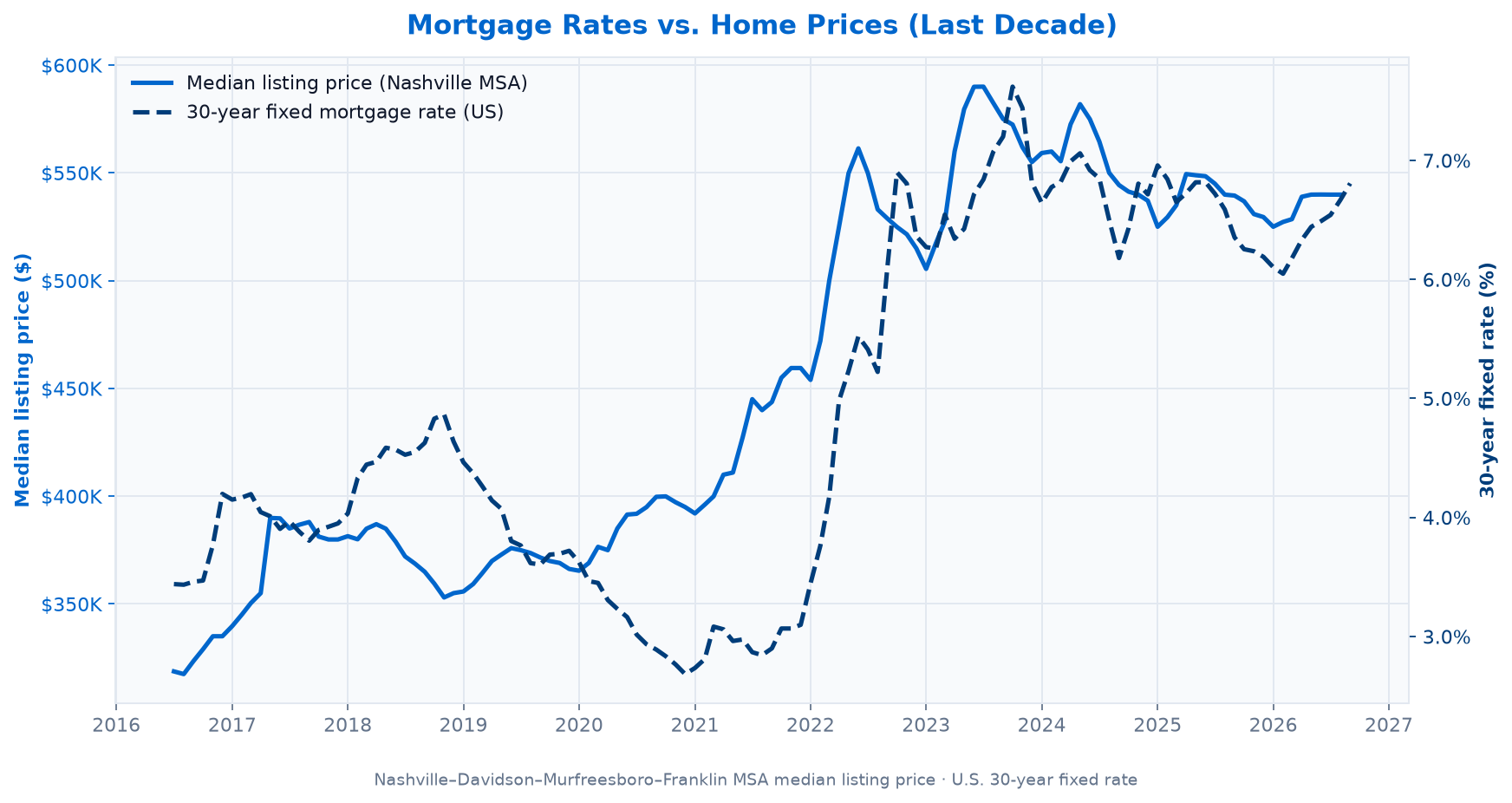
Sources: Median listing prices for the Nashville–Davidson–Murfreesboro–Franklin, TN metro (CBSA) are from Realtor.com’s Housing Inventory Core Metrics, FRED series MEDLISPRI34980, monthly through August 2026. U.S. 30-year fixed mortgage rates are from the Freddie Mac Primary Mortgage Market Survey, FRED series MORTGAGE30US; weekly observations were averaged to monthly values through September 2026 (latest weekly print September 17, 2026). Listing prices reflect asking prices, not closed sale prices. Data retrieved from the Federal Reserve Bank of St. Louis FRED database.
Buyers and sellers: practical reads
For buyers in Murfreesboro and Middle Tennessee
• Use the inventory build—especially listings past 30 days—to negotiate price, closing-cost help, and lender rate buydowns.
• Get fully underwritten early; soft national application volume does not mean every well-priced home will wait.
• Compare fixed vs. short-term ARM quotes carefully; ARMs are rising in share nationally for a reason, but they are a risk tool, not a free lunch.
For sellers
• Price to the last 90 days of comps in your tier, not to 2022 peaks. Mid-tier medians are flat; average gains live higher up.
• Expect longer list-to-contract timelines where payment-sensitive demand is thin.
• If your home is turnkey and well located, you can still win; aspirational pricing joins the growing active pool.
For the high end
• Demand remains selective rather than absent. Presentation, pricing discipline, and the right buyer pool matter more than Fed headlines alone.
Bottom line
Middle Tennessee’s residential market is not crashing—it is stalling where lending and income meet the mid-tier. Inventory is heavier. Closings are harder to earn. High-end activity is relatively steadier. Until mortgage costs ease or wages catch payment reality, expect a market that rewards preparation over urgency.
Talk with the CBS Realty team for market guidance tailored to buyers and sellers in Murfreesboro and Middle Tennessee—pricing strategy, negotiation leverage, and how today’s rate environment shapes your next move. Explore listings and local insights at cbs-tn.com.